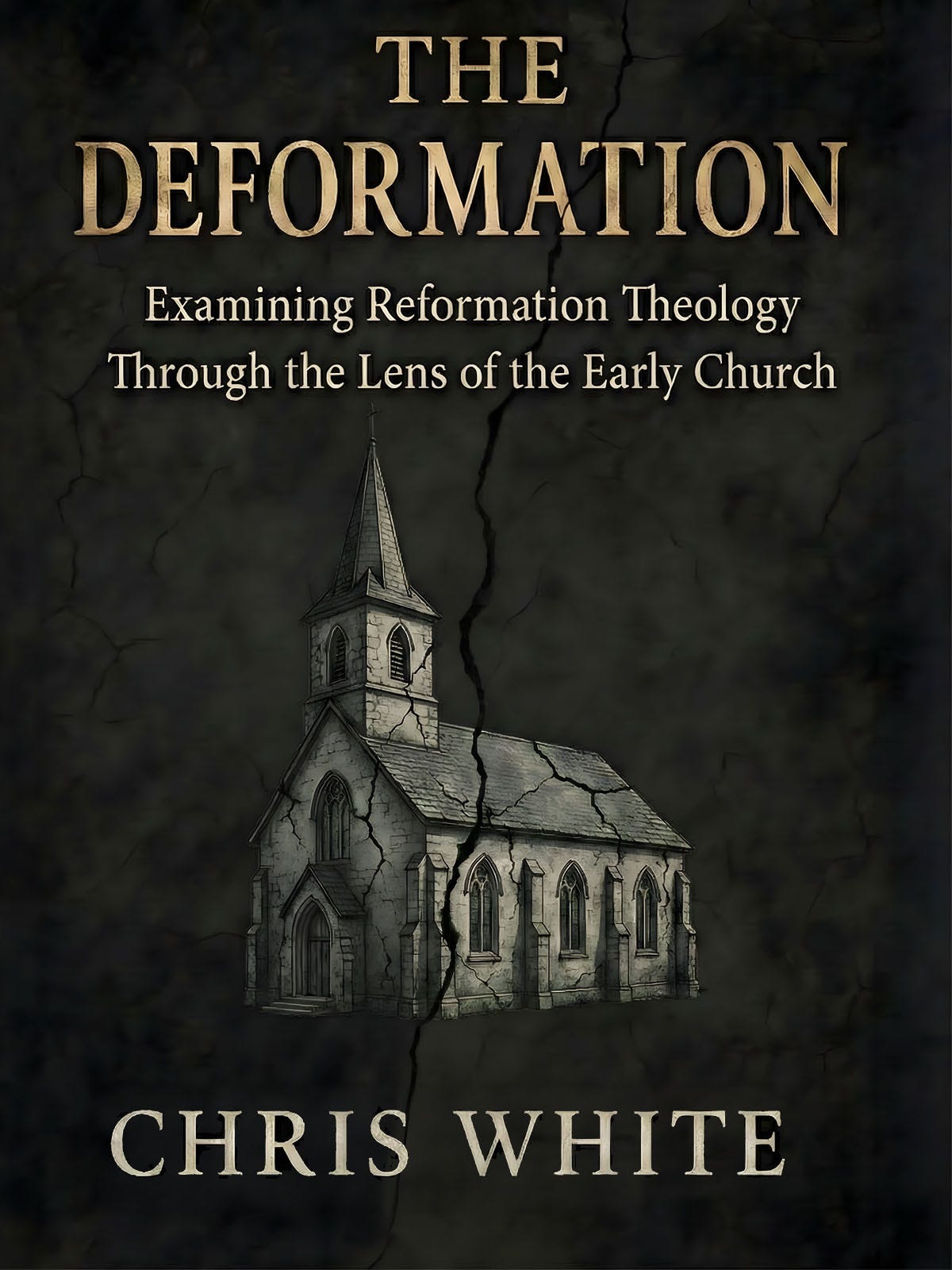
We often comfort ourselves with a particular story. We picture the Reformers—Luther, Calvin, and others—as restoring the original gospel after centuries of Roman Catholic corruption. And it is true that the Catholic Church had departed in significant ways from the teaching of the apostles.
But the Reformers didn’t restore what the early church taught.
In trying to correct Roman Catholic theology, they significantly overcorrected, and in many cases ended up with brand new ideas that the earliest Christians outright rejected in their writings.
For most of my life, I accepted the standard narrative without question. But a few years ago, I began asking a simple but dangerous question: What did the earliest Christians actually believe?
I wasn’t looking for medieval monks. I wanted to hear from the men who knew the Apostles—men like Clement of Rome, Ignatius, and Polycarp—or those who lived just a generation later, like Irenaeus and Justin Martyr.
The doctrines I had been told were the “bedrock of orthodoxy”—doctrines like Total Depravity, Unconditional Election, and Penal Substitutionary Atonement—were completely absent from the first 300 years of the church. In fact, when many of these ideas did appear in the ancient world, they weren’t taught by Christians. They were taught by the Gnostics, the very heretics the early church battled against.
This discovery led to my new book, The Deformation: Examining Reformation Theology Through The Lens of the Early Church.
A Fresh and Honest Look
The Deformation invites readers to take a fresh and honest look at several foundational teachings of the Reformation—such as total depravity, penal substitutionary atonement, the meaning of “works of the law,” the role of free will, and the interpretation of the Sermon on the Mount.
Through careful examination of Scripture and consistent reference to early Christian thought, I demonstrate that many of these doctrines were not a recovery of ancient Christianity, but a significant departure from it.
Here is a glimpse of what is inside:
- The Gnostic Roots of T.U.L.I.P.: How the doctrines of “Total Depravity” and “Unconditional Election” mirror the pagan determinism rejected by the early Christians.
- The Redefinition of “Works”: How Martin Luther redefined Paul’s “works of the law” (Jewish rituals) to mean any effort to obey God, turning Jesus’ call to holiness into “legalism.”
- The Sermon on the Mount: Why the Reformers viewed Jesus’ teachings as a “divine goad” designed to crush us, while the early church viewed them as the path of discipleship.
- Atonement: How we traded the early church’s view of the Cross (a victory over death and Satan) for a medieval theory of God pouring out His wrath on Jesus.
- Romans 9: A verse-by-verse breakdown showing why Paul was talking about God’s mercy to nations, not picking individuals for hell.
Not New Doctrines, But Ancient Ones
This book is not an attempt to offer new doctrines, nor is it a rejection of church history. Instead, it is a call to evaluate familiar theological ideas in the clear light of the Bible—and to compare them, when appropriate, with the beliefs of the first Christians, whose voices are often forgotten in modern debate.
Whether you are a pastor, student, or thoughtful believer wrestling with questions about salvation, grace, and the teachings of Jesus, The Deformation provides clarity, challenge, and a renewed appreciation for the depth and coherence of the earliest Christian faith.
I hope you’ll join me in examining the evidence.
You can get a copy of The Deformation on Amazon here: https://a.co/d/dnuNAZS