I wanted to post and let you all know that I will be pausing the Vine Abiders livestream, as my wife’s cancer has recurred and I want to spend more time taking care of her.
I will continue to post videos on the Vine Abiders YouTube channel periodically as time allows, but the livestreams will be paused until further notice.
In Part 3 of the Lord’s Prayer series, Vine Abiders takes a deep dive into the line, “Lead us not into temptation, but deliver us from evil,” framing it as a daily prayer for strength, clarity, and spiritual protection. This episode continues the broader study of the Sermon on the Mount, emphasizing that Jesus teaches believers to pray not for distant outcomes, but for faithfulness and endurance today.
Vine Abiders reflects on how the Lord’s Prayer reshapes prayer life by narrowing our focus to daily dependence on God—daily bread, daily forgiveness, and daily strength. Rather than being overwhelmed by future anxieties, this approach invites believers to bring even small, ordinary challenges before God, recognizing that every day carries its own trials and temptations. By praying specifically for what we need today, faith is strengthened as we begin to see God’s provision more clearly and consistently.
A major theme of the episode is the important distinction between trials and temptations. While Scripture teaches that God allows trials for growth and maturity, temptation itself comes from the evil one. Drawing from Matthew, James, and Ephesians, Vine Abiders explains how this part of the Lord’s Prayer functions as a spiritual warfare prayer—not focused on dramatic manifestations, but on the daily battle to resist sin within hardship. Trials may be good and even necessary, but within them lie real temptations that require God’s protection and strength to overcome.
The Book of Job serves as a central example, illustrating that the true test in suffering is not merely endurance, but faithfulness without sin, especially resisting bitterness, resentment, and unbelief. Job’s story shows that spiritual victory is found in maintaining integrity before God, even when circumstances are devastating and answers are unclear.
The episode also challenges common modern assumptions about temptation, Satan’s role, and spiritual warfare, arguing that resisting sin—not avoiding suffering—is at the heart of the Christian life. Listeners are encouraged to see each day, and especially life’s “evil days,” as moments where choices matter deeply and where God’s grace provides a real path to victory.
Ultimately, this teaching calls believers to walk in humble dependence on God, praying daily for protection from temptation, deliverance from the evil one, and fresh strength to remain faithful—whatever the day may bring.
In Part Two of the Lord’s Prayer series, Vine Abiders examines the meaning and implications of the petition, “Forgive us our debts, as we also have forgiven our debtors.” The discussion begins by clarifying the biblical language behind “debts,” “sins,” and “trespasses,” showing how these terms point to the same spiritual reality across the Gospels.
The episode addresses two major theological tensions: why believers are instructed to regularly ask God for forgiveness, and why Scripture consistently ties God’s forgiveness of us to our willingness to forgive others. Through passages from Matthew, Mark, Luke, James, and 1 John, Vine Abiders argues that forgiveness in the Christian life is relational and conditional, not merely symbolic or optional.
Drawing heavily from early Church writers such as Clement of Rome, John Chrysostom, and Cyril of Jerusalem, the teaching highlights how the earliest Christians understood ongoing repentance and forgiveness as essential to abiding in Christ. The episode contrasts this perspective with modern evangelical and Calvinist interpretations that view forgiveness as entirely settled once-for-all, critiquing the idea that future sins are automatically forgiven.
The second half of the teaching focuses on forgiveness toward others, showing how unforgiveness can lead to bitterness, spiritual damage, and even falling away. Numerous New Testament passages are examined to demonstrate that forgiving others is not optional but central to faithful Christian discipleship.
Ultimately, this episode calls believers to take Jesus’ words seriously—to walk in repentance, extend mercy freely, and remain rooted in Christ through obedience, humility, and love.
To stay connected and receive updates, writings, and teachings, visit the Vine Abiders Substack: 👉 https://vineabiders.substack.com
In this episode of Vine Abiders, Chris White resumes a verse-by-verse study of the Sermon on the Mount, focusing on Matthew 6:9–13 and the first half of the Lord’s Prayer. This teaching explores why Jesus explicitly commanded His followers to pray these words, and how the early church understood the prayer as a formative, kingdom-centered practice—not empty repetition.
The discussion begins by placing the Lord’s Prayer in its immediate context, contrasting it with hypocritical, performative prayer and pagan-style repetition. From there, Chris walks through each phrase in detail, showing how the prayer reorients the believer toward God’s glory before personal needs.
Topics include:
The meaning and significance of addressing God as “Our Father”, emphasizing both intimacy and corporate identity
The balance of closeness and reverence in “who is in heaven”
Why “Hallowed be Your name” is best understood as a petition—a request that God’s name be treated as holy
The kingdom-centered focus of “Your kingdom come”, including its Jewish background and subversive implications
“Your will be done on earth as it is in heaven” as daily surrender, alignment with God’s purposes, and spiritual conflict
A deep look at “Give us this day our daily bread,” including its rare Greek wording, daily dependence on God, trust, generosity, and spiritual sustenance
The episode also offers practical reflections on prayer as a way of entrusting daily needs to God, growing faith, and learning dependence rather than anxiety.
This is Part One of the Lord’s Prayer study. The remaining petitions—confession, forgiveness, temptation, and deliverance—will be covered in the next episode.
📬 Subscribe to Vine Abiders on Substack for live stream alerts, articles, and podcast updates: 👉 https://vineabiders.substack.com
We often comfort ourselves with a particular story. We picture the Reformers—Luther, Calvin, and others—as restoring the original gospel after centuries of Roman Catholic corruption. And it is true that the Catholic Church had departed in significant ways from the teaching of the apostles.
But the Reformers didn’t restore what the early church taught.
In trying to correct Roman Catholic theology, they significantly overcorrected, and in many cases ended up with brand new ideas that the earliest Christians outright rejected in their writings.
For most of my life, I accepted the standard narrative without question. But a few years ago, I began asking a simple but dangerous question: What did the earliest Christians actually believe?
I wasn’t looking for medieval monks. I wanted to hear from the men who knew the Apostles—men like Clement of Rome, Ignatius, and Polycarp—or those who lived just a generation later, like Irenaeus and Justin Martyr.
The doctrines I had been told were the “bedrock of orthodoxy”—doctrines like Total Depravity, Unconditional Election, and Penal Substitutionary Atonement—were completely absent from the first 300 years of the church. In fact, when many of these ideas did appear in the ancient world, they weren’t taught by Christians. They were taught by the Gnostics, the very heretics the early church battled against.
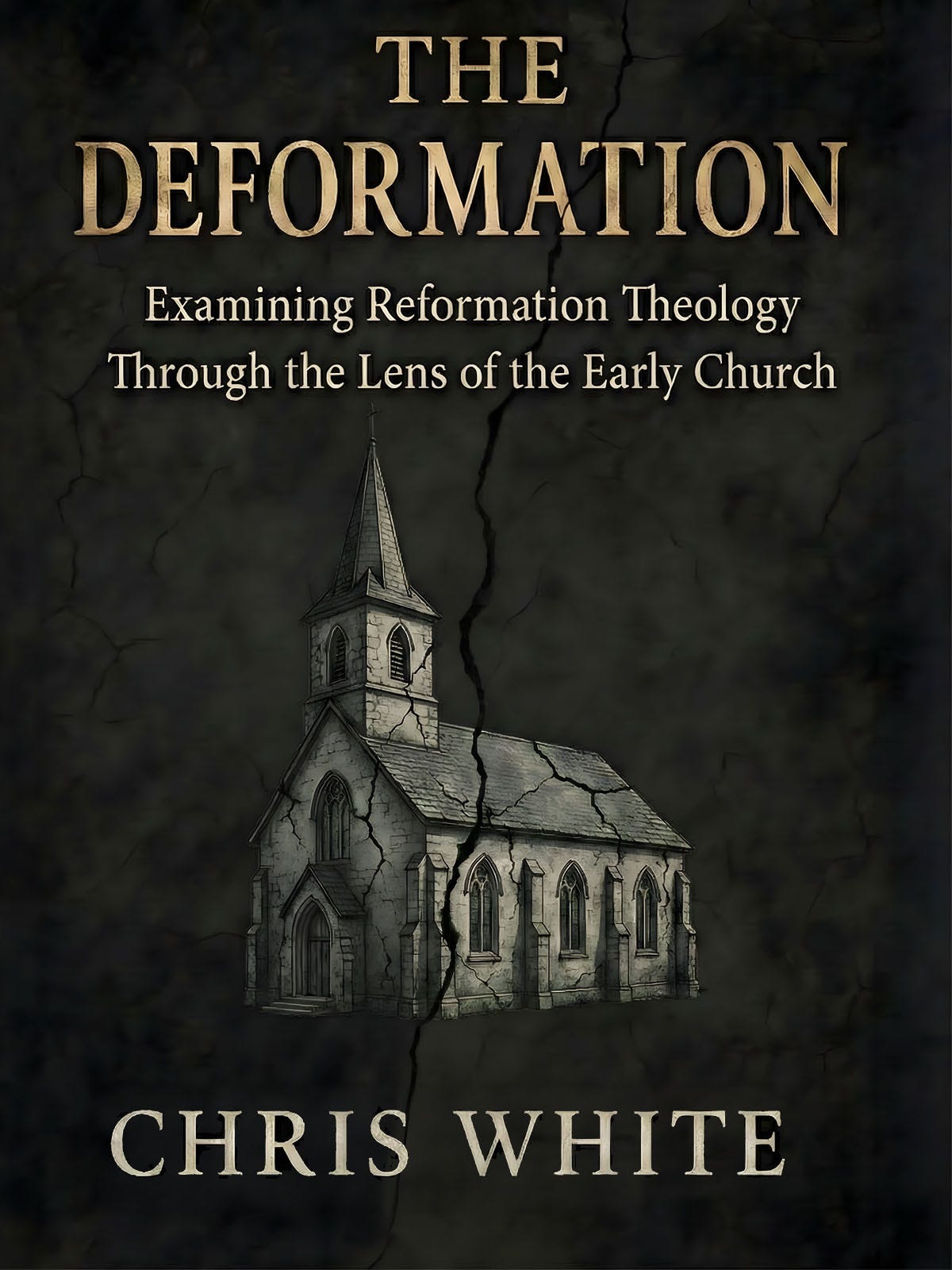
The Deformation invites readers to take a fresh and honest look at several foundational teachings of the Reformation—such as total depravity, penal substitutionary atonement, the meaning of “works of the law,” the role of free will, and the interpretation of the Sermon on the Mount.
Through careful examination of Scripture and consistent reference to early Christian thought, I demonstrate that many of these doctrines were not a recovery of ancient Christianity, but a significant departure from it.
Here is a glimpse of what is inside:
The Gnostic Roots of T.U.L.I.P.: How the doctrines of “Total Depravity” and “Unconditional Election” mirror the pagan determinism rejected by the early Christians.
The Redefinition of “Works”: How Martin Luther redefined Paul’s “works of the law” (Jewish rituals) to mean any effort to obey God, turning Jesus’ call to holiness into “legalism.”
The Sermon on the Mount: Why the Reformers viewed Jesus’ teachings as a “divine goad” designed to crush us, while the early church viewed them as the path of discipleship.
Atonement: How we traded the early church’s view of the Cross (a victory over death and Satan) for a medieval theory of God pouring out His wrath on Jesus.
Romans 9: A verse-by-verse breakdown showing why Paul was talking about God’s mercy to nations, not picking individuals for hell.
Not New Doctrines, But Ancient Ones
This book is not an attempt to offer new doctrines, nor is it a rejection of church history. Instead, it is a call to evaluate familiar theological ideas in the clear light of the Bible—and to compare them, when appropriate, with the beliefs of the first Christians, whose voices are often forgotten in modern debate.
Whether you are a pastor, student, or thoughtful believer wrestling with questions about salvation, grace, and the teachings of Jesus, The Deformation provides clarity, challenge, and a renewed appreciation for the depth and coherence of the earliest Christian faith.
This is the final chapter of my new book, which provides a comprehensive examination of the “Once Saved, Always Saved” doctrine, exploring its historical development, the biblical arguments for and against it, and the implications for Christian living. It is based on a documentary film I produced, titled Once Saved Always Saved – A Documentary Filmavailable for free on Youtube.
The doctrine of “Once Saved, Always Saved” (OSAS), also known as eternal security or the perseverance of the saints, asserts that once a person has truly been born again and received the Holy Spirit, they cannot lose their salvation regardless of their subsequent actions or choices.
Historical Development of the Doctrine
Early Church Understanding
The early church, did not teach eternal security. The earliest Christian writings outside the New Testament consistently affirm the possibility that true believers can fall away from faith.
The early Church Fathers emphasized the necessity of perseverance and holy living. They taught that while salvation is initiated by God’s grace, if you turned back to your life of sin after being saved, and had not repented before death, you would go to hell.
Justin Martyr:
“I hold further that those of you who have confessed and known this man to be Christ, yet who have gone back for some reason to the legal dispensation and have denied that this man is Christ and have not repented before death, you will by no means be saved.”
Cyprian said:
“And you are still in the world. You are still in the battlefield. You daily fight for your lives. So you must be careful that what you have begun to be with, such a blessed commencement, will be consummated in you. It is a small thing to at first receive something. It is a greater thing to be able to keep what you have attained. Faith itself and the saving birth do not make a life by merely being received. Rather, they must be preserved.”
Origen wrote about one group of Gnostics:
“They essentially destroy free will by introducing ruined natures incapable of salvation and by introducing others as being saved in such a way that they cannot be lost.”
Irenaeus said:
“But as to themselves [speaking of the Gnostics], they hold that they shall be entirely and undoubtedly saved, not by means of conduct, but because they are spiritual by nature. It is impossible that spiritual substance by which they mean themselves should ever come under the power of corruption. Wherefore also it comes to pass that the most perfect among them addict themselves without fear to all kinds of forbidden deeds of which the Scriptures assure us that they who do such things shall not inherit the kingdom of God. They run us down, [that is the true Christians], who from the fear of God guard against sinning even in thought or word as utterly contemptible.”
Augustine’s Influence
A significant shift occurred with Augustine of Hippo (354–430 AD), whose theological contributions profoundly impacted Christian doctrine. Initially, Augustine emphasized free will and the necessity of human cooperation with divine grace. However, in response to the Pelagian controversy, Augustine developed a theology that taught that free will was an illusion.
Augustine began to assert that those whom God has predestined will inevitably persevere in faith. He maintained that God’s grace is irresistible and that the elect cannot ultimately fall away. This laid the groundwork for later doctrines of eternal security. Although Augustine himself did not go so far as to teach “once saved, always saved,” he did set the stage for it.
The Reformation and Calvinism
The Protestant Reformation in the 16th century brought renewed focus on the doctrine of salvation. It was John Calvin who developed the full doctrine of eternal security as commonly taught today. Calvin diverged not only from the early church tradition but even from other Reformation leaders in this teaching.
This Reformed doctrine then spread through Protestant churches, though many traditions such as Lutherans, Methodists, Pentecostals and Anabaptists, did not adopt once saved, always saved.
Scriptural Warnings Against Apostasy
The New Testament contains over 50 warning passages cautioning believers about the danger of falling away
. The sheer volume and intensity of these warnings pose a significant challenge to OSAS theology. Major warning passages include:
Hebrews 6:4–6
One of the most debated passages concerning apostasy is found in Hebrews 6:4–6:
“For in the case of those who have once been enlightened and have tasted of the heavenly gift and have been made partakers of the Holy Spirit, and have tasted the good word of God and the powers of the age to come, and then have fallen away, it is impossible to renew them again to repentance, since they again crucify to themselves the Son of God and put Him to open shame.” (Hebrews 6:4–6)
This passage describes individuals who have genuinely experienced aspects of salvation:
Once been enlightened: They have received spiritual illumination and understanding.
Tasted of the heavenly gift: They have experienced the blessings of salvation.
Partakers of the Holy Spirit: They have shared in the Holy Spirit’s presence and work.
Tasted the good word of God and the powers of the age to come: They have personally experienced the truth of God’s word and witnessed the manifestations of God’s power.
Despite these profound experiences, the passage warns about the possibility of falling away (parapesontas in Greek), which implies a deliberate and decisive turn away from the faith. The reason given is that they are effectively re-crucifying the Son of God and subjecting Him to public disgrace. This severe warning suggests that apostasy is not only possible but carries irreversible consequences. This passage challenges the OSAS doctrine by indicating that true believers can choose to reject their salvation and that such a decision leads to dire, even irrevocable, consequences.
Hebrews 10:26–31
Further emphasizing the gravity of apostasy, Hebrews 10 states:
“For if we go on sinning willfully after receiving the knowledge of the truth, there no longer remains a sacrifice for sins, but a terrifying expectation of judgment and THE FURY OF A FIRE WHICH WILL CONSUME THE ADVERSARIES. Anyone who has set aside the Law of Moses dies without mercy on the testimony of two or three witnesses. How much severer punishment do you think he will deserve who has trampled under foot the Son of God, and has regarded as unclean the blood of the covenant by which he was sanctified, and has insulted the Spirit of grace? For we know Him who said, ‘VENGEANCE IS MINE, I WILL REPAY.’ And again, ‘THE LORD WILL JUDGE HIS PEOPLE.’ It is a terrifying thing to fall into the hands of the living God.” (Hebrews 10:26–31)
The author addresses believers (”we”) who have received the knowledge of the truth. The warning is against willful sinning after this reception. The term “sinning willfully” implies a persistent and deliberate continuation in sin, not mere occasional lapses.
The consequences of such willful sin are severe:
No longer remains a sacrifice for sins: The efficacy of Christ’s sacrifice is nullified for those who persist in deliberate sin.
Terrifying expectation of judgment: Instead of assurance, there is a fearful anticipation of God’s righteous judgment.
Fury of a fire which will consume the adversaries: The language echoes divine judgment in hell.
The author compares the severity of rejecting Christ to the punishment under the Law of Moses. If those who violated the Mosaic Law died without mercy, how much more severe is the punishment for those who:
Trampled under foot the Son of God: Showing utter contempt for Jesus.
Regarded as unclean the blood of the covenant by which he was sanctified: Disrespecting the sanctifying work of Christ’s blood.
Insulted the Spirit of grace: Offending the Holy Spirit.
The inclusion of “by which he was sanctified” indicates that the person in question had been sanctified, or set apart, by Christ’s blood—suggesting they were genuine believers.
2 Peter 2:20–22
The Apostle Peter also warns about the danger of returning to a sinful lifestyle after knowing Christ:
“For if, after they have escaped the defilements of the world by the knowledge of the Lord and Savior Jesus Christ, they are again entangled in them and are overcome, the last state has become worse for them than the first. For it would be better for them not to have known the way of righteousness, than having known it, to turn away from the holy commandment handed on to them. It has happened to them according to the true proverb, ‘A DOG RETURNS TO ITS OWN VOMIT,’ and, ‘A sow, after washing, returns to wallowing in the mire.’” (2 Peter 2:20–22)
Peter speaks of individuals who have:
Escaped the defilements of the world: They have broken free from sinful corruption.
By the knowledge of the Lord and Savior Jesus Christ: This “knowledge” (epignōsei in Greek) denotes a full, experiential knowledge, not mere awareness.
Despite this, they become entangled again in the world’s defilements and are overcome. Peter asserts that their last state has become worse than the first. He explains that it would have been better for them not to have known the way of righteousness than to have known it and then turned away.
The use of proverbs reinforces the severity of their condition. “A dog returns to its own vomit” indicates a return to what was previously rejected and harmful. “A sow, after washing, returns to wallowing in the mire” suggests a regression to an unclean state after being cleansed. This passage emphasizes that knowing Christ and then deliberately turning away results in a worse state than before conversion, which suggests that their eternal punishment will be worse for them than if they had never been saved in the first place.
James 5:19–20
James addresses the community of believers regarding the importance of restoring those who wander:
“My brethren, if any among you strays from the truth and one turns him back, let him know that he who turns a sinner from the error of his way will save his soul from death and will cover a multitude of sins.” (James 5:19–20)
Several key points emerge:
“My brethren,” “Among you”: James is speaking to fellow believers.
“If any among you strays from the truth”: Acknowledging that believers can stray from the Christian faith and practice.
“Will save his soul from death”: The stakes are high—spiritual death is the consequence of straying without repentance.
This passage underscores that believers are not immune to wandering and that returning a straying believer is crucial for their salvation. It implies that continued deviation from the truth can lead to spiritual death, challenging the idea that salvation is unconditionally secure.
1 Corinthians 9:24–27
Paul describes his own discipline to avoid disqualification:
“Do you not know that those who run in a race all run, but only one receives the prize? Run in such a way that you may win. Everyone who competes in the games exercises self-control in all things. They then do it to receive a perishable wreath, but we an imperishable. Therefore I run in such a way, as not without aim; I box in such a way, as not beating the air; but I discipline my body and make it my slave, so that, after I have preached to others, I myself will not be disqualified.” (1 Corinthians 9:24–27)
Paul says, “I discipline my body and make it my slave,” showing that he practices self-control to remain faithful. He also says, “So that… I myself will not be disqualified,” acknowledging the possibility that even he could be disqualified (Greek: adokimos, meaning rejected). This suggests that continual discipline and perseverance are necessary to avoid falling short of the ultimate prize—eternal life.
Revelation 3:5
In the letter to the church in Sardis, Jesus promises:
“He who overcomes will thus be clothed in white garments; and I will not erase his name from the book of life…” (Revelation 3:5)
In context the promise is conditional upon overcoming, i.e., remaining faithful. The phrase “I will not erase his name from the book of life” implies that names can be erased, suggesting the possibility of losing one’s place in the book of life. This reinforces the idea that perseverance is essential and that salvation is contingent upon continued faithfulness.
Romans 11:17–22
The Apostle Paul warns the Gentile believers in Rome about the necessity of continuing in faith to remain in God’s kindness:
“If some of the branches were broken off, and you, being a wild olive, were grafted in among them and became a partaker with them of the rich root of the olive tree, do not be arrogant toward the branches; but if you are arrogant, remember that it is not you who supports the root, but the root supports you. You will say then, ‘Branches were broken off so that I might be grafted in.’ Quite right, they were broken off for their unbelief, but you stand by your faith. Do not be conceited, but fear; for if God did not spare the natural branches, He will not spare you, either. Behold then the kindness and severity of God: to those who fell, severity, but to you, God’s kindness, if you continue in His kindness; for otherwise, you too will be cut off.” (Romans 11:17–22)
Paul warns, “If God did not spare the natural branches, He will not spare you, either,” a sober warning that believers are not exempt from judgment. He adds, “If you continue in His kindness,” showing that salvation requires perseverance in faith. Finally, he concludes, “Otherwise, you too will be cut off,” demonstrating that separation from God is a real possibility for those who do not continue in faith.
Matthew 10:22
Jesus teaches His disciples about the necessity of enduring faith in the face of persecution:
“You will be hated by everyone because of My name, but it is the one who has endured to the end who will be saved.” (Matthew 10:22)
Salvation is contingent on perseverance through trials (”The one who has endured to the end”). This passage underscores that enduring faith is essential for salvation. It challenges the belief that salvation is guaranteed.
Matthew 7:21–23
Jesus warns about the importance of doing the Father’s will:
“Not everyone who says to Me, ‘Lord, Lord,’ will enter the kingdom of heaven, but he who does the will of My Father who is in heaven will enter. Many will say to Me on that day, ‘Lord, Lord, did we not prophesy in Your name, and in Your name cast out demons, and in Your name perform many miracles?’ And then I will declare to them, ‘I never knew you; depart from Me, you who practice lawlessness.’” (Matthew 7:21–23)
Mere verbal profession (”Lord, Lord”) is insufficient; obedience is essential (”He who does the will of My Father”). The declaration “I never knew you” indicates no relationship due to ongoing lawlessness. This passage emphasizes that knowing Jesus requires more than words; it requires obedience and alignment with God’s will. Those who practice lawlessness, even if they perform miracles, are denied entry into the kingdom.
2 Peter 1:10–11
Peter urges believers to be diligent:
“Therefore, brethren, be all the more diligent to make certain about His calling and choosing you; for as long as you practice these things, you will never stumble; for in this way the entrance into the eternal kingdom of our Lord and Savior Jesus Christ will be abundantly supplied to you.” (2 Peter 1:10–11)
Peter exhorts believers to “be all the more diligent to make certain” about their calling. He notes that assurance is conditional: “As long as you practice these things… you will never stumble.” This passage suggests that perseverance in godliness is necessary to secure one’s entrance into the eternal kingdom.
These scriptural warnings challenge the doctrine of “Once Saved, Always Saved” by emphasizing that salvation is not an irrevocable status granted regardless of one’s actions. Instead, salvation requires ongoing faith, obedience, and perseverance. While God’s grace is abundant and His desire is that none should perish (2 Peter 3:9), the responsibility to respond faithfully rests with each individual. Believers are called to “work out your salvation with fear and trembling” (Philippians 2:12), recognizing the seriousness of their commitment to Christ.
Interpretation of Key Passages Supporting Eternal Security
Proponents of OSAS frequently point to specific passages as proof that salvation cannot be lost. However, a closer examination reveals that these passages do not actually support the doctrine of OSAS.
John 10:27–30
“My sheep listen to My voice, and I know them, and they follow Me; and I give them eternal life, and they will never perish; and no one will snatch them out of My hand. My Father, who has given them to Me, is greater than all; and no one is able to snatch them out of the Father’s hand. I and the Father are one.” (John 10:27–30)
Conditional Elements:
“My sheep listen to My voice, and they follow Me.” The promise of eternal life is given to those who continue to listen to, and follow Jesus. This is an ongoing action, implying that remaining His sheep is contingent on obedience and faithfulness.
“No one will snatch them out of My hand.” While external forces cannot remove a believer from Christ, the text does not exclude the possibility of a sheep wandering away by its own choice, consistent with free will. The passage assures the safety of believers who remain faithful but does not guarantee unconditional security regardless of behavior.
Romans 8:29–30
This “golden chain” of salvation is often interpreted to mean an unbroken sequence from foreknowledge to glorification.
“For those whom He foreknew, He also predestined to become conformed to the image of His Son, so that He would be the firstborn among many brothers and sisters; and these whom He predestined, He also called; and these whom He called, He also justified; and these whom He justified, He also glorified.” (Romans 8:29–30)
Calvinists often treat Romans 8:28–30—the so-called “golden chain”—as proof that everyone God calls will inevitably be justified and glorified. But Paul is not making that claim. As John Wesley observed, Paul is describing the pattern of God’s saving work, not asserting that the same individuals unbreakably move from predestination to calling to justification to glorification. Paul never says that all who are called are justified, nor that all who are justified will necessarily be glorified. In fact, he elsewhere warns explicitly that believers can fall away after having been “in” the covenant (Romans 11:22). The broader New Testament also contradicts the idea that each step guarantees the next: Jesus teaches that “many are called, but few are chosen,” Peter commands believers to “make your calling and election sure,” and Hebrews cautions that the righteous (justified) can “draw back” to destruction. These passages show that Romans 8 describes God’s saving initiative, not an unbreakable sequence that rules out apostasy. Far from teaching eternal security, the text assumes the ongoing necessity of perseverance.
Earlier in the chapter, Paul warns that “if you are living in accordance with the flesh, you are going to die; but if by the Spirit you are putting to death the deeds of the body, you will live” (Romans 8:13). This conditional statement shows that the promises in Romans 8 are tied to the believer’s active participation in the Spirit’s work.
Ephesians 1:13–14
“In Him, you also, after listening to the message of truth, the gospel of your salvation—having also believed, you were sealed in Him with the Holy Spirit of the promise, who is a first installment of our inheritance, in regard to the redemption of God’s own possession, to the praise of His glory.” (Ephesians 1:13–14)
Advocates of once-saved-always-saved often point to Ephesians 1:13–14, where believers are said to be “sealed with the Holy Spirit,” as if Paul meant to teach that salvation is permanently guaranteed. But in the ancient world, a seal was not an unbreakable force-field—it was simply a stamp of ownership or authentication, and both Paul and his readers knew full well that seals could in fact be broken. Seals on wine jars, letters, or legal documents could be, removed, or broken. The same is true of the word “earnest” (arrabōn), sometimes translated “guarantee.” “Guarantee” can misleadingly suggest unconditional permanence, but in Greek the word refers to earnest money—a down payment, the first installment of what is to come. Paul’s point is that the Spirit is the beginning of God’s work in us, the initial deposit of the inheritance we hope to receive, not an automatic guarantee of its final reception. The Spirit’s presence gives us assurance, not eternal security. Paul repeatedly describes the Spirit as the evidence that we belong to God—shaping our desires, empowering obedience, and bearing witness that we are God’s children (Rom. 8; Gal. 4). None of this implies that the Spirit cannot be resisted or forfeited.
In the very same letter, Paul warns believers not to grieve the Holy Spirit by whom they were sealed (Eph. 4:30). This warning echoes Isaiah 63:10, where Israel grieved God’s Spirit and consequently became His enemies—an unmistakable indication that the presence of God’s Spirit does not make apostasy impossible. Paul also cautions the Ephesians not to be deceived into thinking that those who live in immorality will inherit the kingdom (Eph. 5:3–7). If sealing were an unbreakable guarantee, Paul’s warnings would be incoherent. Scripture teaches that we can accept the Spirit, resist Him, grieve Him, quench Him. The sealing of the Spirit marks us as God’s people, but it does not eliminate the possibility of falling away; it provides present assurance and power, not an unconditional guarantee of final salvation.
Romans 7: The Wretched Man
“I find then the principle that evil is present in me, the one who wants to do good. For I joyfully concur with the law of God in the inner man, but I see a different law in the members of my body, waging war against the law of my mind and making me a prisoner of the law of sin which is in my members. Wretched man that I am! Who will set me free from the body of this death?” (Romans 7:21–24)
Romans 7 has long been a cornerstone passage for OSAS proponents, who often interpret it as a depiction of the typical Christian life. They argue that Paul’s description of an ongoing struggle with sin demonstrates the believer’s inability to overcome sin in this life in any meaningful way, reinforcing the idea that salvation is secure regardless of one’s failures.
Early Church Interpretation
For the first few centuries of church history, the early church overwhelmingly understood Romans 7 as Paul speaking about his life before salvation. It wasn’t until Augustine that the interpretation shifted to suggest Paul was describing the ongoing struggle of a believer. Augustine’s view proposed that Paul, as a Christian, was confessing his inability to overcome sin and his enslavement to it. This interpretation, however, stands in stark contrast to the tone and content of Paul’s other writings. Nowhere else in his epistles does Paul depict the Christian life as one of helplessness and defeat by sin. For this reason alone, great caution is warranted when interpreting Romans 7 as a paradigm for the believer’s normal experience.
Contextual Analysis
To understand Romans 7, it is essential to consider the surrounding chapters—Romans 6 and Romans 8—as part of a unified argument. Separating these chapters leads to a distorted view of Paul’s teaching.
In Romans 6, Paul is explicit that the believer’s relationship to sin has fundamentally changed. Through baptism, we have died to sin, been buried with Christ, and raised to walk in newness of life (Romans 6:2–4). He commands believers to “consider yourselves dead to sin, but alive to God in Christ Jesus” (Romans 6:11). Paul goes even further: “Do not let sin reign in your mortal body” (Romans 6:12), “do not present your members to sin as instruments of unrighteousness” (6:13), and most decisively, “sin shall not have dominion over you” (6:14). In the same chapter he insists that believers have “become obedient from the heart” (6:17), have been “set free from sin and become slaves of righteousness” (6:18), and are now living lives that lead to sanctification and, ultimately, eternal life (6:22).
Romans 7 is digression in which Paul recounts the futility of trying to achieve righteousness under the law of Moses. This chapter vividly illustrates the frustration and defeat experienced by someone attempting to live a godly life apart from the Spirit’s power.
Romans 8 begins by answering the anguished question of Romans 7:24—“Who will deliver me from this body of death?”—with a clear and decisive response: Jesus Christ sets him free (7:25). What the man in Romans 7 cannot accomplish through his own power—obedience, holiness, victory over sin—is now made possible through the indwelling Holy Spirit. Romans 8 exists to show that the commands of Romans 6 become achievable not by human strength but by the Spirit’s power.
Whereas the Romans 7 man is a “prisoner of the law of sin” (7:23), Paul declares that “the law of the Spirit of life in Christ Jesus has set you free from the law of sin and death” (8:2). Instead of being dominated by sinful impulses, believers now “set their minds on the things of the Spirit” (8:5–6), “put to death the deeds of the body” by the Spirit (8:13), and are “led by the Spirit of God” as true sons and daughters (8:14). In short, Romans 8 is Paul’s proclamation that the Spirit accomplishes what the flesh cannot, revealing that the misery of Romans 7 is not the normal Christian life but the life from which Christ has freed us.
Unfortunately, some have used Romans 7 as justification for a life of ongoing sin, claiming that it is normal for Christians to remain enslaved to sin. This misuse distorts Paul’s intent. Paul repeatedly warns in his letters that those who live in sin will not inherit the kingdom of God (e.g., 1 Corinthians 6:9–10, Galatians 5:19–21).
Sinless Perfection?
The charge that teaching obedience to Christ implies a doctrine of sinless perfection is a misunderstanding of the biblical message. The call to live faithfully as a disciple of Jesus has never meant achieving sinlessness in this life.
Scripture acknowledges the reality of human frailty and the possibility of sin. For instance, 1 John 2:1 assures believers that, while sin may occur, we have “an Advocate with the Father, Jesus Christ the righteous.” This verse does not suggest an expectation of sinless living but rather provides the comfort and assurance that forgiveness is available for those who repent and seek God’s mercy.
When a believer stumbles, the Spirit convicts and enables them to get up, confess their sin, and continue walking faithfully. The Christian life however is characterized by steady progress, moving “from glory to glory” (2 Corinthians 3:18), as the Spirit transforms believers into the likeness of Christ.
Faithfulness involves growing in maturity and holiness, not remaining stagnant or excusing sin but continually striving to align one’s life with God’s will. While missteps may occur along the way, the pattern of a faithful life is one of upward growth, steady progress, and a deepening relationship with God.
The Call to Fear, Holiness, and Repentance
The Bible’s teachings on salvation, holiness, and repentance are clear: God’s grace is abundant, but it is not to be taken lightly. The words of Jesus and the apostles consistently call for a life of reverent fear, holy living, and genuine repentance, challenging the modern complacency fostered by the doctrine of once saved, always saved.
The Fear of the Lord
Jesus warned His disciples directly:
“Do not fear those who kill the body but are unable to kill the soul; but rather fear Him who is able to destroy both soul and body in hell.” (Matthew 10:28)
Fear is one of the foundations for sanctification, as Paul reminds us to:
“Perfect holiness in the fear of God” (2 Corinthians 7:1)
Similarly, the author of Hebrews urges believers:
“Therefore, let’s fear if, while a promise remains of entering His rest, any one of you may seem to have come short of it.” (Hebrews 4:1)
The fear of the Lord inspires vigilance, a sensitivity to the Holy Spirit’s conviction, and a determination to avoid sin.
Holy Living and Victory Over Sin
The call to holiness is not optional. It is the very will of God for His people:
“For this is the will of God, your sanctification.” (1 Thessalonians 4:3)
The writer of Hebrews is equally explicit:
“Pursue peace with all people, and the holiness without which no one will see the Lord.” (Hebrews 12:14)
Living after the flesh leads to spiritual death, but through the Holy Spirit, believers can put to death the deeds of the flesh (Romans 8:13). This victory is not an unattainable ideal; it is the expectation for every believer. Paul reminds us:
“No temptation has overtaken you except something common to mankind; and God is faithful, so He will not allow you to be tempted beyond what you are able, but with the temptation will provide the way of escape also, so that you will be able to endure it.” (1 Corinthians 10:13)
The victorious life does not mean sinless perfection, but it does mean a consistent pattern of resisting sin, denying oneself, and pursuing godliness. Jesus commanded:
“If anyone wants to come after Me, he must deny himself, take up his cross daily, and follow Me.” (Luke 9:23)
The Nature of True Repentance
Repentance is more than an emotional response; it is a decisive turning away from sin and turning toward God. The Greek word metanoia conveys this transformation:
True repentance results in a change of mind, heart, and behavior. It is the beginning of a journey on the narrow road that leads to life, in contrast to the broad road that leads to destruction (Matthew 7:13–14). The apostle Peter described this turning point:
“Therefore repent and return, so that your sins may be wiped away, in order that times of refreshing may come from the presence of the Lord.” (Acts 3:19)
Repentance is not about perfection but about realignment with God’s will, forsaking the sin that separates us from Him.
A Sobering Reminder
From Genesis to Revelation, the message remains consistent: God hates sin, and He holds humanity accountable for the choices we make. He has granted us free will, and with it comes the responsibility to respond to His grace and walk in obedience.
“For the grace of God has appeared, bringing salvation to all people, instructing us to deny ungodliness and worldly desires and to live sensibly, righteously, and in a godly manner in the present age.” (Titus 2:11–12)
“See to it that no one comes short of the grace of God.” (Hebrews 12:15)
In the end, the path we choose is our own, and the consequences are eternal. As the Scriptures have shown us, no one will have an excuse if they fail to give diligence to what is written. May we, therefore, strive to live as those who honor God, fearing Him, walking in holiness, and holding fast to the hope of eternal life.
In this episode of Vine Abiders, Chris begins the next section of the Sermon on the Mount, exploring Matthew 6:1–6 and Jesus’ command to practice righteousness in secret. What does it mean to give, pray, and fast in a way that pleases God rather than seeking the praise of people? Chris unpacks the often-overlooked sin of vainglory, explains why Jesus emphasizes secrecy in spiritual disciplines, and explores the Bible’s surprising and repeated teaching about rewards—both in heaven and in this life. This episode examines how our motives shape our spiritual lives and why believing that God “rewards those who seek Him” is central to authentic Christian faith.
You’ll also hear an update about the Joyful Hearts Home orphanage project in Kenya, which Chris White Ministries supports. If you’d like to follow that journey, learn more, or join in supporting the children there, see the links below.
“You have heard that it was said, ‘You shall love your neighbor and hate your enemy.’ But I say to you, love your enemies and pray for those who persecute you, so that you may be sons of your Father who is in heaven.”
This teaching goes far beyond what most of us think possible. Jesus isn’t giving us poetic advice—He’s commanding us to live like our Father in heaven, who “causes His sun to rise on the evil and the good.”
Some interpreters believe the phrase “hate your enemy” was Jesus referring to certain rabbinic or cultural traditions of His day. The Dead Sea Scrolls, written by the Essene community at Qumran, even instructed initiates to “love all the sons of light and hate all the sons of darkness” (1QS 1:9–11). You can read this text at: https://intertextual.bible/text/1qs.1-matthew-5.43
Welcome back to Vine Abiders, where we study the words of Jesus verse by verse and learn what it really means to live as His disciples. In this study, we’ve come to one of the most misunderstood teachings in all of Scripture — “An eye for an eye and a tooth for a tooth.”
For many of us, that phrase immediately brings to mind vengeance or retribution — the idea of getting even. But as we’ll see, that’s not what the law originally meant at all. Jesus wasn’t overturning the Old Testament here; He was deepening it, revealing the heart behind it.
This section of the Sermon on the Mount, found in Matthew 5:38–42, teaches something radical: the way of non-resistance — not retaliating when wronged, not clinging to our rights, and trusting God to be our defender.
The Pattern of the Sermon on the Mount
Throughout this section of the Sermon on the Mount, Jesus follows a clear pattern.
He quotes a command from the Old Testament — “You have heard that it was said…” — and then amplifies it to reveal the deeper heart behind the law:
“You shall not murder” → Don’t even be angry.
“You shall not commit adultery” → Don’t even lust.
“Love your neighbor” → Love even your enemies.
In each case, Jesus affirms the law’s moral foundation, but then intensifies it. He takes it from the realm of outward compliance to inward transformation.
So when He says, “You have heard that it was said, ‘An eye for an eye and a tooth for a tooth,’” He isn’t contradicting Moses. He’s revealing the spiritual principle beneath it — and pushing it further.
What “An Eye for an Eye” Really Meant
The law of “eye for eye, tooth for tooth” comes from Leviticus 24:17–20 and similar passages in Exodus 21 and Deuteronomy 19.
“If a man injures his neighbor, just as he has done, so it shall be done to him: fracture for fracture, eye for eye, tooth for tooth.”
This wasn’t a call to revenge. It was a sentencing guideline — a judicial principle of proportional justice. Its purpose was to limit punishment, not to encourage it. It was designed to ensure that justice was measured, fair, and equal — preventing the endless cycles of blood feuds that plagued ancient societies.
In fact, this law was rarely practiced literally in Israel’s history. Over time, it was replaced by monetary compensation. By Jesus’ day, Israel was under Roman occupation and had no authority to carry out capital punishment — that’s why the Jews had to bring Jesus before Pilate.
Why These Laws Existed
God gave these laws to Israel as a way to restrain sin and preserve holiness in a fallen world. They acted as guardrails, protecting His people from moral chaos.
In a small, tightly knit community where disobedience carried severe consequences, sin was taken seriously. Even if we call that “legalism,” it worked. It kept evil in check.
But Israel drifted from this system. By the time of the Judges, Scripture says, “Everyone did what was right in his own eyes.” The guardrails were gone — and corruption flourished.
A Law Meant to Limit Vengeance
For years, I misunderstood this verse. I thought Jesus was overturning the Old Testament, saying, “The law told you to take revenge, but I tell you not to.”
But that’s not what’s happening.
Jesus wasn’t rejecting the Mosaic law — He was affirming its intent and intensifying its application.
The original law — “eye for an eye” — limited vengeance. Jesus takes it a step further:
“You’ve heard it said: Don’t take more than what’s owed. But I say: Don’t take vengeance at all. Don’t even resist an evil person.”
That’s the pattern we’ve seen all along. It’s not reversal, it’s revelation.
A Biblical Example: Escalating Vengeance
In Genesis 34, when Dinah was raped, her brothers responded by killing every man in the city. That’s vengeance without restraint — a tragic example of how quickly justice can spiral into bloodshed.
The law of “eye for an eye” was meant to stop that cycle — to prevent violence from escalating endlessly.
Where vengeance multiplies destruction, God’s justice limits it.
Justice vs. Vengeance
There’s a crucial difference between justice and vengeance.
When justice is carried out lawfully, within God’s order, it’s obedience. But when someone takes matters into their own hands — acting outside of that system — it becomes vengeance.
That’s true both in ancient Israel and today. Even in modern courts, when a judge issues a sentence according to the law, it’s not personal revenge. It’s the lawful administration of justice.
In the same way, when God commanded Israel to carry out sentences, it wasn’t about emotional retaliation — it was about obedience to His law.
The Call to Non-Resistance
Then Jesus takes it deeper.
“Do not resist an evil person. If someone slaps you on the right cheek, turn to him the other also.”
This is one of the hardest teachings in Scripture. It’s the call to non-retaliation — to live in a way that mirrors Christ’s meekness, even when wronged.
The early church took this seriously. In the first few centuries of Christianity, non-resistance was one of the defining marks of a true disciple.
They believed Jesus meant what He said. And because they lived that way, they stood out in a world of violence and pride.
The Apostles Reaffirm the Same Teaching
Paul, Peter, and the early church all reaffirm this same principle.
Romans 12:17–21 says:
“Never pay back evil for evil to anyone… Never take your own revenge… Do not be overcome by evil, but overcome evil with good.”
1 Thessalonians 5:15:
“See that no one repays another with evil for evil.”
1 Peter 3:9:
“Do not return evil for evil or insult for insult, but give a blessing instead.”
The apostles didn’t soften Jesus’ command. They doubled down on it.
Why Vengeance Feels So Good — and Why It’s So Dangerous
There’s a reason we love revenge stories. They light up something in our brains — that little dopamine hit when the bad guy “gets what’s coming.”
But Jesus calls us to walk away from that emotional payoff. That’s not the Kingdom’s way.
Ignatius, one of the early church fathers, said:
“When you are wronged, be patient. When slandered, bless. When persecuted, endure. When hated, return love. When cursed, pray.”
That’s what it means to follow Christ.
Martin Luther’s Reversal
Interestingly, Martin Luther rejected this teaching outright. He called it “foolishness” to turn the other cheek. To Luther, the Sermon on the Mount wasn’t meant to be lived — it was meant to show us that we can’t live it.
He believed Jesus’ impossible standard was meant only to drive us to grace.
But that interpretation — though influential — departs from how the early church read these words. They saw the Sermon on the Mount not as an unattainable ideal, but as a blueprint for discipleship.
And they lived it — even when it cost them their lives.
When You’re Wronged
Jesus also says,
“If anyone wants to sue you and take your shirt, let him have your coat also.”
That’s not natural. It’s faith in action.
Paul echoes this in 1 Corinthians 6:7:
“Why not rather be wronged? Why not rather be defrauded?”
That’s radical obedience. It’s trusting God when you’re being mistreated.
Why? Because obedience isn’t about results — it’s about trust. God says, “Vengeance is Mine.” Do we trust Him enough to let Him handle it?
The Second Mile
“If anyone forces you to go one mile, go with him two.”
Roman soldiers had the right to force civilians to carry their packs for one mile. Jesus tells His followers to go two.
That’s not weakness — that’s witness. That’s showing the world what grace looks like in action.
Giving Without Resistance
“Give to him who asks of you, and do not turn away from him who wants to borrow from you.”
This isn’t just about generosity — it’s about non-resistance in giving. When someone asks, we don’t withhold.
It’s a call to open-handedness — to live with the same self-giving spirit that Jesus displayed.
Why Live This Way?
Why would anyone live like this — refusing to retaliate, giving up their rights, letting others take advantage?
Because Jesus promised there’s a reward for those who do.
“Love your enemies, do good, lend expecting nothing in return, and your reward will be great, and you will be sons of the Most High.” — Luke 6:35–36
“Blessed are those who are persecuted for righteousness’ sake, for theirs is the kingdom of heaven.” — Matthew 5:10
“If you are insulted for the name of Christ, you are blessed, because the Spirit of glory and of God rests upon you.” — 1 Peter 4:14
When we refuse vengeance, God takes up our cause. He shapes our character, strengthens our hope, and uses our lives as a witness to the world.
Conclusion: The Way of Trust
God’s eye is on the one who refuses vengeance. He fights for them, provides for them, shapes them, and uses their obedience to change others.
That’s faith — trusting that if we live His way, He’ll take care of the rest.
The early church believed that, lived that, and the world was never the same.
TL;DL
The Reformers taught that God legally credits Christ’s perfect obedience to believers—an unchangeable courtroom verdict called imputed righteousness.But Scripture’s emphasis is not on a legal transfer; it’s on union with Christ—a living participation in His life. Our righteousness isn’t Christ’s moral record applied to us, but God’s righteousness shared with us through being in Him.
In this view, salvation is relational and dynamic, not static or abstract. Remaining or abiding in Christ is essential; righteousness endures only as long as that union does. The call to holiness is therefore not optional but vital, because our standing before God depends on abiding in the Righteous One, not merely on a past declaration.
See the full post on Substack here https://substack.com/@vineabiders
“Again, you have heard that the ancients were told, ‘You shall not make false vows, but shall fulfill your vows to the Lord.’ But I say to you, make no oath at all, either by heaven, for it is the throne of God, or by the earth, for it is the footstool of His feet, or by Jerusalem, for it is the city of the great King. Nor shall you make an oath by your head, for you cannot make one hair white or black. But let your statement be, ‘Yes, yes’ or ‘No, no’; anything beyond these is of evil.” YouVersion | The Bible App | Bible.com
Jesus here is not merely refining how we swear; He is forbidding oath-making entirely.
And later, James 5:12 NASB reinforces the same teaching:
“But above all, my brothers and sisters, do not swear, either by heaven or by earth or with any other oath; but your yes is to be yes, and your no, no, so that you may not fall under judgment.” YouVersion | The Bible App | Bible.com
With those texts in view, let us walk through what the Bible teaches about oaths and vows, why this is serious, and how it applies today.
Oaths vs. Vows — Clarifying the Terms
To understand what Jesus forbids, we should distinguish between oaths and vows (or solemn promises).
Oath: a public guarantee of one’s speech or promise, often invoking God or something sacred to validate one’s truthfulness (e.g. “I swear before God that this is true”). It is directed toward assuring others of your sincerity or faithfulness.
Vow: a solemn promise or dedication made before God, binding oneself to some act, abstention, service, or offering (e.g. a personal vow to fast, a Nazirite vow, or in some forms a marriage vow).
The difference is subtle but important: oaths are about proving the truth of one’s statement, often by invoking God’s name, whereas vows are about committing oneself before God. The Bible treats both seriously—but in different categories.
Biblical Foundations: Why Oaths Are Prohibited, Vows Are Regulated
Old Testament Context
The Old Testament contains many passages about oaths and vows. A few examples:
Numbers 30:2 (NASB):
“If a man makes a vow to the LORD, or swears an oath to bind himself by a pledge, he shall not break his word; he shall do according to all that proceeds out of his mouth.”
Deuteronomy 23:21–23 (NASB) says in part:
“When you make a vow to the LORD your God, you shall not delay to pay it, for the LORD your God will certainly require it of you; and if you refrain from vowing, it would not be a sin in you. But you shall be careful to fulfill what has passed your lips, for you vowed to the LORD your God what you have promised with your mouth.”
Ecclesiastes 5:4–5 (NASB) warns:
“When you vow a vow to God, do not delay in paying it; for He has no pleasure in fools. Pay what you vow. Better not to vow than to vow and not pay.”
From these, we see that:
Vows are not abolished—but once made, they are serious and must be honored.
God expects integrity: if you set your word before Him, you should fulfill it.
The failure to vow is not, in itself, sin; but making a vow lightly is dangerous.
Also, the Third Commandment—“You shall not take the name of the Lord your God in vain” (Exodus 20:7)—is widely understood to forbid not only profanity but also misuse of God’s name, including perjury (using God’s name to back up false statements). In Leviticus 19:12 we read:
“You shall not swear falsely by My name, so I will not hold guiltless the one who takes My name in vain. I am the LORD.”
Violating an oath made in God’s name is, thus, a serious defilement—dragging His name into a lie.
Historical examples underscore God’s seriousness:
Saul and the Gibeonites (2 Samuel 21): Because Saul broke a long-standing oath to the Gibeonites, Israel faced famine and reaped dire consequences.
Zedekiah’s oath to Babylon (2 Chronicles 36; Ezekiel 17): Though his oath was to a pagan king, God judged him for violating it—showing that oaths sworn even to unbelievers carry weight before the Lord.
These examples demonstrate that God regards oaths as binding—even toward those who are not God’s people.
Jesus’ Teaching: A Radical Prohibition
In the Sermon on the Mount, Jesus radicalizes the old commands. Rather than permitting oaths under certain conditions, He says:
“make no oath at all … But let your statement be, ‘Yes, yes’ or ‘No, no’; anything beyond these is of evil.”
He is sweeping away the loopholes and excusing formulas the Pharisees employed (e.g. “I swear by the temple, but not by the gold of the temple”). In doing so, He insists on a posture of sincerity and utter simplicity. His followers are to live in such honesty that no oath is needed.
James echoes this command nearly in the same words:
“Do not swear … but your yes is to be yes, and your no, no, so that you may not fall under judgment.”
Jesus’ and James’ warnings: invoking God’s name to reinforce our word is unnecessary if our life is built on truthfulness. Reliance on outward guarantees points to a deeper lack of integrity.
Why Oaths Matter to God
Borrowing God’s reputation When we swear by God, we are effectively putting His name on the line for our truthfulness. If we break our oath, we not only break trust with the person but we bring dishonor onto God, dragging His reputation into falsehood.
Character disclosure Jesus’ command implies that Christians ought to exhibit such consistent truthfulness that no additional assurance is needed. Integrity should characterize every word we speak—so “Yes” is trusted, “No” is trusted, without needing external guarantees.
Accountability and judgment The text warns that those who misuse oaths may fall under God’s judgment. It signals that God doesn’t take lightly what His name is enlisted into.
Modern Applications: Where Oaths Appear Today
Let’s look at some modern contexts in which oaths arise, and how a Christian committed to Jesus’ teaching might handle them.
Legal & Civil Oaths
Court oaths / affidavits
Jury oaths
Public office oaths
Citizenship oaths
In many legal systems (especially in the U.S.), one can legally affirm rather than swear an oath. Christians historically (e.g. Quakers, Mennonites, Amish) have used affirmations to avoid swearing by God’s name while still giving a binding pledge. If forced to choose, one should request an affirmation and avoid religious language like “so help me God” or raising ones hand etc.
Military Service & Allegiance Oaths
This is one area where things start to overlap with other serious questions for Christians—like violence, allegiance, and obedience to Christ. The early church took Jesus’ words about oaths very seriously, but they also took other words of His just as literally—particularly the command to love your enemies.
For them, loving your enemies meant not killing them. That conviction, combined with Jesus’ clear prohibition against taking oaths, was one of the main reasons early Christians refused to join the military. They couldn’t reconcile swearing allegiance to Caesar or pledging to obey military commands with following the One who said, “Do not resist an evil person.”
If this is something you’re wrestling with, I’d really encourage watching a short documentary called What If Jesus Meant Every Word That He Said? It’s a thought-provoking look at how some people in the military have wrestled with taking Jesus’ teachings seriously—especially on non-violence and allegiance.
As for me, I’m still working through all of this too. I don’t claim to have it all figured out. But I do know that if you’re in the military or thinking about joining, the oath issue alone should at least give you pause. The same goes for anyone taking any kind of formal pledge of allegiance.
If you’re convicted by Jesus’ teaching about oaths, there may be alternatives available. Most branches of service or government institutions have provisions for people who object to oath-taking on religious grounds—usually an “affirmation” clause that removes the religious invocation. But even so, I’d say there are bigger issues at play in the military context than just the oath itself.
Marriage Vows
Marriage is a covenant. The Bible does not prescribe a fixed ceremonial vow formula, but many modern wedding vows function similarly to oaths (“I vow to … before God …”). While these are not explicitly prohibited, we should treat them as solemn promises, with caution regarding invoking God’s name lightly. Simplifying them to clear affirmations of covenant might better reflect the spirit of Jesus’ teaching.
What to Do When Past Oaths or Vows Are Broken
If you have taken oaths or made vows and have not kept them:
Confess before God, seeking His mercy.
Where possible, fulfill the vow or oath in a righteous way (if it is not sinful).
In some cases—if the vow was rash, frivolous, or sinful—prayerful repentance and seeking God’s guidance is appropriate rather than attempting fulfillment at all cost.
From now on, commit to speaking truthfully without reliance on oaths.
The key is not to despair but to become more faithful in speech from here forward.
Living Without Oaths — A Witness of Integrity
Most of us have made statements like “I swear to God,” or promised “I’ll never do X” in strong terms. But now that we see the weight of those words, we are called to a higher path: let our “Yes” be “Yes,” and our “No” be “No”—with no need for oath-making.
A Christian who lives this way will manifest consistent integrity, and the world may see in that reliability a quiet but powerful testimony to the God we serve.
Join Chris White on Vine Abiders, a Bible study podcast and livestream where we walk through the Sermon on the Mount verse by verse. In this session, we’re looking at Matthew 5:31–32, where Jesus teaches on divorce and remarriage.
Chris will share highlights from his book Remarriage After Divorce: A Biblical Defense of the Traditional Christian View(written under the initials C.A. White). We’ll explore:
The three main Christian views on divorce and remarriage.
Why the early church was nearly unanimous in forbidding remarriage while a spouse still lived.
How the Reformation shifted the discussion.
What Jesus and Paul actually said about this difficult subject.
The hard questions Christians face today if already remarried.
Whether you’re wrestling with these teachings yourself or just want to understand Scripture more deeply, this study will give historical, biblical, and theological context to one of Jesus’ most challenging passages.
Audio Podcast Links
Itunes:
Spotify:
Deformation Series on Substack:
The Deformation 1 – The Early Church vs Modern Christians
In this Vine Abiders livestream, we continue our series through the Sermon on the Mount and dive into one of the most direct and challenging passages—Matthew 5:27–30 on lust. Jesus equates lust with adultery of the heart and warns of eternal consequences, leaving no room for compromise. We’ll explore how the early church understood and taught this passage, why modern interpretations often dilute its meaning, and what it truly means to take Christ’s words seriously.
Along the way, I share my own testimony of freedom from lust and pornography, the principle of “the first look is temptation, the second look is sin,” and the role of the fear of the Lord in breaking free from bondage. We’ll look at supporting scriptures across the New Testament, discuss the reality of hell, and consider practical steps to walk in holiness without loopholes or compromise.
Whether you’re struggling with lust yourself, wrestling with what Jesus really meant, or simply seeking to grow in sanctification, this teaching is both sobering and hopeful—pointing to the power of repentance, the Holy Spirit, and the treasure of the fear of the Lord.
Welcome back to the Vine Abiders study. We are continuing our walk through the Sermon on the Mount. Last week, we began looking at Jesus’ “new commandments” in Matthew 5:21–22, where He equates anger with murder. This week, we move into verses 23–26, which are still about anger, but focus more on its consequences.
Recap: Jesus on Anger (Matthew 5:21–22)
Jesus says: “You have heard that the ancients were told, ‘You shall not commit murder,’ and ‘Whoever commits murder shall be liable to the court.’ But I say to you that everyone who is angry with his brother shall be guilty before the court; and whoever says to his brother, ‘You good-for-nothing,’ shall be guilty before the Supreme Court; and whoever says, ‘You fool,’ shall be guilty enough to go into the fiery hell.”
We asked the question: what are we going to do with Jesus’ teaching? He seems to be giving us new commandments to follow, which is very different from the way most evangelical churches present this passage. Luther and later Protestant tradition often taught that Jesus’ impossible commands were simply meant to show us we cannot obey. But the early church understood differently. Polycarp, a disciple of John the Apostle, said: “He who raised Him up from the dead will raise us up also, if we do His will and walk in His commandments, and love what He loved, keeping ourselves from all unrighteousness, covetousness, love of money, evil speaking, false witness, not rendering evil for evil, railing for railing, blow for blow, or cursing for cursing.”
The early church was consistent. They did not teach sinless perfection. They did not teach salvation by works. They taught that salvation is free and undeserved, but that abiding in Christ means continuing in Him—keeping His commandments by the power of the Spirit. When Jesus says anger is equivalent to murder, He is stating truth, not exaggeration. Indulging lust means the only thing keeping you from adultery is opportunity. Indulging anger means the only thing keeping you from murder is opportunity. Virtue is not found in the absence of opportunity; it is found in resisting the desire itself.
Anger as Addiction
Anger is addictive. Biochemically, it produces dopamine just like alcohol, pornography, or gambling. The strongest dopamine rush comes when anger feels justified—when someone cuts you off in traffic, when rage-bait floods your feed, or when you see someone “get what’s coming to them.”
For years I believed anger and lust could not be resisted, that temptation always led to sin. But I came to realize something simple and life-changing: “The first look is temptation. The second look is sin.” I can’t avoid seeing the girl walking down the street. I can’t avoid the initial spark of anger when I’m wronged. But I can resist indulging it. That’s the difference, and that’s where victory lies. Like any addiction, it’s hard at first, but resisting gets easier with practice. Resist the devil, and he will flee.
The Fear of the Lord
No one overcomes a loved addiction without something monumental motivating them. Meth addicts know it destroys them but keep using. Anger is no different. What then is strong enough to break its hold? The Bible tells us: the fear of the Lord.
Isaiah 33:6 calls it “His treasure.” Proverbs 14:27 says, “The fear of the Lord is a fountain of life, that one may avoid the snares of death.” Proverbs 16:6 declares, “By the fear of the Lord one keeps away from evil.”
Do not let anyone steal this treasure from you. Many churches today downplay the fear of God, redefining it as mere reverence. But Scripture is clear: fear is fear. Jesus Himself warned about hell repeatedly, and the early church embraced holy fear as the path away from sin. Without it, the bondage of anger will never be broken.
Anger and Prayer
Matthew 5:23–24 says, “Therefore, if you are presenting your offering at the altar, and there remember that your brother has something against you, leave your offering there before the altar and go; first be reconciled to your brother, and then come and present your offering.”
Jesus says reconciliation is a higher priority than sacrifice, even higher than prayer. Before you pray, forgive. Mark 11:25–26 reinforces this: “Whenever you stand praying, forgive, if you have anything against anyone, so that your Father who is in heaven will also forgive you your transgressions. But if you do not forgive, neither will your Father forgive your transgressions.”
Peter writes in 1 Peter 3:7 that husbands must honor their wives “so that your prayers will not be hindered.” He goes on to say, “The eyes of the Lord are toward the righteous, and His ears attend to their prayer, but the face of the Lord is against those who do evil.”
If you feel like your prayers are dead, consider whether unforgiveness is at the root. Scripture is blunt: God will not hear the prayers of those who will not forgive.
Doors to the Enemy
Paul warns in Ephesians 4:26–27: “Be angry, and do not sin; do not let the sun go down on your anger, and give no opportunity to the devil.” Anger gives Satan a foothold. Bitterness grieves the Holy Spirit. Cain’s story in Genesis 4 illustrates this. God told him, “Sin is crouching at the door; its desire is for you, but you must master it.” Cain refused, and his anger led to murder.
Hebrews 12:14–15 warns that bitterness can cause many to be defiled, and that those who refuse to pursue peace and sanctification “will not see the Lord.” This is not a minor issue. Anger, left unchecked, can destroy faith itself.
Settle Quickly
Jesus continues in Matthew 5:25–26: “Make friends quickly with your opponent at law while you are with him on the way, so that your opponent may not hand you over to the judge, and the judge to the officer, and you be thrown into prison. Truly, I say to you, you will not come out of there until you have paid the last penny.”
The immediate context is debtor’s prison in Roman society. But the principle is broader. Settle disputes quickly, before they escalate. Paul echoes this in 1 Corinthians 6, rebuking believers for suing one another. He says, “Why not rather be wronged? Why not rather be defrauded?”
The cure for anger is dying to your rights. If you cling to fairness, you will never find peace. But if you lay down your rights—if you turn the other cheek, if you let go of your coat as well as your shirt, if you walk the extra mile—you will be free.
Practical Steps
Fear God. Recognize that anger can damn the soul. Reconcile quickly. Do not take believers to court. Esteem others higher than yourself. Pray for your enemies, especially those who fuel your anger. Practice losing arguments and letting others have the last word. It is healing to die to self.
Conclusion
Anger may feel justified, but indulging it is deadly. It blocks your prayers, opens doors to Satan, defiles the soul, and endangers salvation. But through the power of the Holy Spirit, through holy fear, and through humble obedience to Jesus, anger can be overcome.
Take Jesus at His word. Reconcile quickly. Forgive freely. Live at peace with all people. The path away from anger is not weakness—it is freedom.
Vine Abiders Resources Podcast: Apple & Spotify (search Vine Abiders) Livestream: Wednesdays at 7 PM EST (YouTube & Facebook) Long-form series: The Deformation Series on Substack
Join me for the first Vine Abiders episode 1, a livestream with Chris White, the producer of the documentary “Once Saved Always Saved?”
Summary:
In Matthew 5, Jesus makes it clear that anger is no small matter. He equates it with murder in the same way He equates lust with adultery. The early church understood this plainly: Jesus meant what He said, and His commandments are to be obeyed. That doesn’t mean sinless perfection, but it does mean living in repentance and taking His words seriously.
For me, the breakthrough came when I realized that sin often boils down to opportunity. If I allow myself the “second look” in lust, then the only thing preventing adultery is whether the right circumstances appear.
The same is true with anger. If I indulge it, then the only thing separating me from murder is opportunity. That’s why Jesus says anger is murder.
I’ve learned that anger functions like an addiction. Biochemically, it produces dopamine just like alcohol, pornography, or any other drug. And the strongest form of this “hit” comes when the anger feels justified—road rage, rage-bait on social media, or the “pleasure” of revenge. It’s no wonder the world is filled with it.
But Jesus provides the antidote: “Do not resist an evil person. Turn the other cheek. Love your enemies. Pray for those who persecute you.” This isn’t weakness—it’s freedom.
In my own walk, I had to confront alcohol first, then lust, and eventually the Lord put His finger on anger. I found myself ruminating, replaying offenses in my mind. That “first thought” of anger is temptation, but dwelling on it—the “second thought”—is sin. Just like lust, it’s possible to stop it with God’s help.
The fear of the Lord is key here. It’s not just reverence—it’s the real fear that Jesus meant what He said and that anger can condemn us. That fear drives us to repentance, and repentance brings freedom.
So how do we actually fight anger? First, recognize when you’re indulging it—whether on the road, in your head, or through endless arguments in your mind—and break the cycle. Take every thought captive. Second, obey Jesus’s direct command: pray for your enemies. When you pray for someone who has wronged you, your heart begins to change. Third, sometimes it helps to make forgiveness tangible. Writing out what someone did to you, how it made you feel, and then intentionally praying over it and crossing it out can be a powerful way to release it to God.
This isn’t legalism. It’s about freedom. The Lord has real power to deliver us from the bondage of anger, just like any other addiction. If we take Him at His word, walk in the fear of the Lord, and obey His commands, we will find not only freedom from anger but also refreshment for our souls.
In this episode, I talk about what I’ve been up to the last few months. I talk about some theology, geopolitics, Bible prophecy, as well as some health conspiracies like vaccines and MTHFR. It’s a good time. Why don’t you just download it?