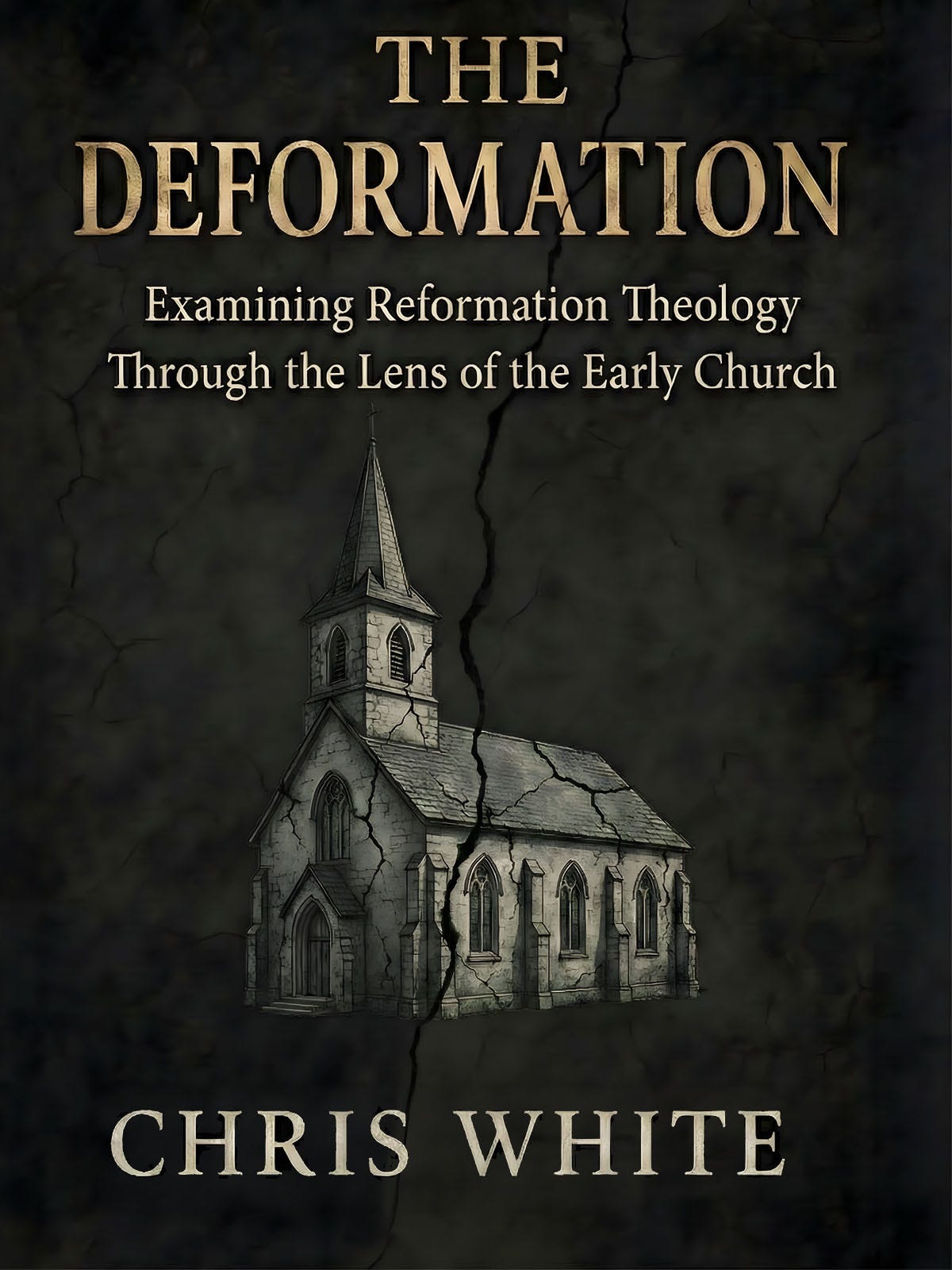
Im exited to announce the publication of my new book The Deformation: Examining Reformation Theology Through The Lens of the Early Church available on Amazon now!
This is the final chapter of my new book, which provides a comprehensive examination of the “Once Saved, Always Saved” doctrine, exploring its historical development, the biblical arguments for and against it, and the implications for Christian living. It is based on a documentary film I produced, titled Once Saved Always Saved – A Documentary Filmavailable for free on Youtube.
The doctrine of “Once Saved, Always Saved” (OSAS), also known as eternal security or the perseverance of the saints, asserts that once a person has truly been born again and received the Holy Spirit, they cannot lose their salvation regardless of their subsequent actions or choices.
Historical Development of the Doctrine
Early Church Understanding
The early church, did not teach eternal security. The earliest Christian writings outside the New Testament consistently affirm the possibility that true believers can fall away from faith.
The early Church Fathers emphasized the necessity of perseverance and holy living. They taught that while salvation is initiated by God’s grace, if you turned back to your life of sin after being saved, and had not repented before death, you would go to hell.
Justin Martyr:
“I hold further that those of you who have confessed and known this man to be Christ, yet who have gone back for some reason to the legal dispensation and have denied that this man is Christ and have not repented before death, you will by no means be saved.”
Cyprian said:
“And you are still in the world. You are still in the battlefield. You daily fight for your lives. So you must be careful that what you have begun to be with, such a blessed commencement, will be consummated in you. It is a small thing to at first receive something. It is a greater thing to be able to keep what you have attained. Faith itself and the saving birth do not make a life by merely being received. Rather, they must be preserved.”
Origen wrote about one group of Gnostics:
“They essentially destroy free will by introducing ruined natures incapable of salvation and by introducing others as being saved in such a way that they cannot be lost.”
Irenaeus said:
“But as to themselves [speaking of the Gnostics], they hold that they shall be entirely and undoubtedly saved, not by means of conduct, but because they are spiritual by nature. It is impossible that spiritual substance by which they mean themselves should ever come under the power of corruption. Wherefore also it comes to pass that the most perfect among them addict themselves without fear to all kinds of forbidden deeds of which the Scriptures assure us that they who do such things shall not inherit the kingdom of God. They run us down, [that is the true Christians], who from the fear of God guard against sinning even in thought or word as utterly contemptible.”
Augustine’s Influence
A significant shift occurred with Augustine of Hippo (354–430 AD), whose theological contributions profoundly impacted Christian doctrine. Initially, Augustine emphasized free will and the necessity of human cooperation with divine grace. However, in response to the Pelagian controversy, Augustine developed a theology that taught that free will was an illusion.
Augustine began to assert that those whom God has predestined will inevitably persevere in faith. He maintained that God’s grace is irresistible and that the elect cannot ultimately fall away. This laid the groundwork for later doctrines of eternal security. Although Augustine himself did not go so far as to teach “once saved, always saved,” he did set the stage for it.
The Reformation and Calvinism
The Protestant Reformation in the 16th century brought renewed focus on the doctrine of salvation. It was John Calvin who developed the full doctrine of eternal security as commonly taught today. Calvin diverged not only from the early church tradition but even from other Reformation leaders in this teaching.
This Reformed doctrine then spread through Protestant churches, though many traditions such as Lutherans, Methodists, Pentecostals and Anabaptists, did not adopt once saved, always saved.
Scriptural Warnings Against Apostasy
The New Testament contains over 50 warning passages cautioning believers about the danger of falling away
. The sheer volume and intensity of these warnings pose a significant challenge to OSAS theology. Major warning passages include:
Hebrews 6:4–6
One of the most debated passages concerning apostasy is found in Hebrews 6:4–6:
“For in the case of those who have once been enlightened and have tasted of the heavenly gift and have been made partakers of the Holy Spirit, and have tasted the good word of God and the powers of the age to come, and then have fallen away, it is impossible to renew them again to repentance, since they again crucify to themselves the Son of God and put Him to open shame.” (Hebrews 6:4–6)
This passage describes individuals who have genuinely experienced aspects of salvation:
- Once been enlightened: They have received spiritual illumination and understanding.
- Tasted of the heavenly gift: They have experienced the blessings of salvation.
- Partakers of the Holy Spirit: They have shared in the Holy Spirit’s presence and work.
- Tasted the good word of God and the powers of the age to come: They have personally experienced the truth of God’s word and witnessed the manifestations of God’s power.
Despite these profound experiences, the passage warns about the possibility of falling away (parapesontas in Greek), which implies a deliberate and decisive turn away from the faith. The reason given is that they are effectively re-crucifying the Son of God and subjecting Him to public disgrace. This severe warning suggests that apostasy is not only possible but carries irreversible consequences. This passage challenges the OSAS doctrine by indicating that true believers can choose to reject their salvation and that such a decision leads to dire, even irrevocable, consequences.
Hebrews 10:26–31
Further emphasizing the gravity of apostasy, Hebrews 10 states:
“For if we go on sinning willfully after receiving the knowledge of the truth, there no longer remains a sacrifice for sins, but a terrifying expectation of judgment and THE FURY OF A FIRE WHICH WILL CONSUME THE ADVERSARIES. Anyone who has set aside the Law of Moses dies without mercy on the testimony of two or three witnesses. How much severer punishment do you think he will deserve who has trampled under foot the Son of God, and has regarded as unclean the blood of the covenant by which he was sanctified, and has insulted the Spirit of grace? For we know Him who said, ‘VENGEANCE IS MINE, I WILL REPAY.’ And again, ‘THE LORD WILL JUDGE HIS PEOPLE.’ It is a terrifying thing to fall into the hands of the living God.” (Hebrews 10:26–31)
The author addresses believers (”we”) who have received the knowledge of the truth. The warning is against willful sinning after this reception. The term “sinning willfully” implies a persistent and deliberate continuation in sin, not mere occasional lapses.
The consequences of such willful sin are severe:
- No longer remains a sacrifice for sins: The efficacy of Christ’s sacrifice is nullified for those who persist in deliberate sin.
- Terrifying expectation of judgment: Instead of assurance, there is a fearful anticipation of God’s righteous judgment.
- Fury of a fire which will consume the adversaries: The language echoes divine judgment in hell.
The author compares the severity of rejecting Christ to the punishment under the Law of Moses. If those who violated the Mosaic Law died without mercy, how much more severe is the punishment for those who:
- Trampled under foot the Son of God: Showing utter contempt for Jesus.
- Regarded as unclean the blood of the covenant by which he was sanctified: Disrespecting the sanctifying work of Christ’s blood.
- Insulted the Spirit of grace: Offending the Holy Spirit.
The inclusion of “by which he was sanctified” indicates that the person in question had been sanctified, or set apart, by Christ’s blood—suggesting they were genuine believers.
2 Peter 2:20–22
The Apostle Peter also warns about the danger of returning to a sinful lifestyle after knowing Christ:
“For if, after they have escaped the defilements of the world by the knowledge of the Lord and Savior Jesus Christ, they are again entangled in them and are overcome, the last state has become worse for them than the first. For it would be better for them not to have known the way of righteousness, than having known it, to turn away from the holy commandment handed on to them. It has happened to them according to the true proverb, ‘A DOG RETURNS TO ITS OWN VOMIT,’ and, ‘A sow, after washing, returns to wallowing in the mire.’” (2 Peter 2:20–22)
Peter speaks of individuals who have:
- Escaped the defilements of the world: They have broken free from sinful corruption.
- By the knowledge of the Lord and Savior Jesus Christ: This “knowledge” (epignōsei in Greek) denotes a full, experiential knowledge, not mere awareness.
Despite this, they become entangled again in the world’s defilements and are overcome. Peter asserts that their last state has become worse than the first. He explains that it would have been better for them not to have known the way of righteousness than to have known it and then turned away.
The use of proverbs reinforces the severity of their condition. “A dog returns to its own vomit” indicates a return to what was previously rejected and harmful. “A sow, after washing, returns to wallowing in the mire” suggests a regression to an unclean state after being cleansed. This passage emphasizes that knowing Christ and then deliberately turning away results in a worse state than before conversion, which suggests that their eternal punishment will be worse for them than if they had never been saved in the first place.
James 5:19–20
James addresses the community of believers regarding the importance of restoring those who wander:
“My brethren, if any among you strays from the truth and one turns him back, let him know that he who turns a sinner from the error of his way will save his soul from death and will cover a multitude of sins.” (James 5:19–20)
Several key points emerge:
- “My brethren,” “Among you”: James is speaking to fellow believers.
- “If any among you strays from the truth”: Acknowledging that believers can stray from the Christian faith and practice.
- “Will save his soul from death”: The stakes are high—spiritual death is the consequence of straying without repentance.
This passage underscores that believers are not immune to wandering and that returning a straying believer is crucial for their salvation. It implies that continued deviation from the truth can lead to spiritual death, challenging the idea that salvation is unconditionally secure.
1 Corinthians 9:24–27
Paul describes his own discipline to avoid disqualification:
“Do you not know that those who run in a race all run, but only one receives the prize? Run in such a way that you may win. Everyone who competes in the games exercises self-control in all things. They then do it to receive a perishable wreath, but we an imperishable. Therefore I run in such a way, as not without aim; I box in such a way, as not beating the air; but I discipline my body and make it my slave, so that, after I have preached to others, I myself will not be disqualified.” (1 Corinthians 9:24–27)
Paul says, “I discipline my body and make it my slave,” showing that he practices self-control to remain faithful. He also says, “So that… I myself will not be disqualified,” acknowledging the possibility that even he could be disqualified (Greek: adokimos, meaning rejected). This suggests that continual discipline and perseverance are necessary to avoid falling short of the ultimate prize—eternal life.
Revelation 3:5
In the letter to the church in Sardis, Jesus promises:
“He who overcomes will thus be clothed in white garments; and I will not erase his name from the book of life…” (Revelation 3:5)
In context the promise is conditional upon overcoming, i.e., remaining faithful. The phrase “I will not erase his name from the book of life” implies that names can be erased, suggesting the possibility of losing one’s place in the book of life. This reinforces the idea that perseverance is essential and that salvation is contingent upon continued faithfulness.
Romans 11:17–22
The Apostle Paul warns the Gentile believers in Rome about the necessity of continuing in faith to remain in God’s kindness:
“If some of the branches were broken off, and you, being a wild olive, were grafted in among them and became a partaker with them of the rich root of the olive tree, do not be arrogant toward the branches; but if you are arrogant, remember that it is not you who supports the root, but the root supports you. You will say then, ‘Branches were broken off so that I might be grafted in.’ Quite right, they were broken off for their unbelief, but you stand by your faith. Do not be conceited, but fear; for if God did not spare the natural branches, He will not spare you, either. Behold then the kindness and severity of God: to those who fell, severity, but to you, God’s kindness, if you continue in His kindness; for otherwise, you too will be cut off.” (Romans 11:17–22)
Paul warns, “If God did not spare the natural branches, He will not spare you, either,” a sober warning that believers are not exempt from judgment. He adds, “If you continue in His kindness,” showing that salvation requires perseverance in faith. Finally, he concludes, “Otherwise, you too will be cut off,” demonstrating that separation from God is a real possibility for those who do not continue in faith.
Matthew 10:22
Jesus teaches His disciples about the necessity of enduring faith in the face of persecution:
“You will be hated by everyone because of My name, but it is the one who has endured to the end who will be saved.” (Matthew 10:22)
Salvation is contingent on perseverance through trials (”The one who has endured to the end”). This passage underscores that enduring faith is essential for salvation. It challenges the belief that salvation is guaranteed.
Matthew 7:21–23
Jesus warns about the importance of doing the Father’s will:
“Not everyone who says to Me, ‘Lord, Lord,’ will enter the kingdom of heaven, but he who does the will of My Father who is in heaven will enter. Many will say to Me on that day, ‘Lord, Lord, did we not prophesy in Your name, and in Your name cast out demons, and in Your name perform many miracles?’ And then I will declare to them, ‘I never knew you; depart from Me, you who practice lawlessness.’” (Matthew 7:21–23)
Mere verbal profession (”Lord, Lord”) is insufficient; obedience is essential (”He who does the will of My Father”). The declaration “I never knew you” indicates no relationship due to ongoing lawlessness. This passage emphasizes that knowing Jesus requires more than words; it requires obedience and alignment with God’s will. Those who practice lawlessness, even if they perform miracles, are denied entry into the kingdom.
2 Peter 1:10–11
Peter urges believers to be diligent:
“Therefore, brethren, be all the more diligent to make certain about His calling and choosing you; for as long as you practice these things, you will never stumble; for in this way the entrance into the eternal kingdom of our Lord and Savior Jesus Christ will be abundantly supplied to you.” (2 Peter 1:10–11)
Peter exhorts believers to “be all the more diligent to make certain” about their calling. He notes that assurance is conditional: “As long as you practice these things… you will never stumble.” This passage suggests that perseverance in godliness is necessary to secure one’s entrance into the eternal kingdom.
These scriptural warnings challenge the doctrine of “Once Saved, Always Saved” by emphasizing that salvation is not an irrevocable status granted regardless of one’s actions. Instead, salvation requires ongoing faith, obedience, and perseverance. While God’s grace is abundant and His desire is that none should perish (2 Peter 3:9), the responsibility to respond faithfully rests with each individual. Believers are called to “work out your salvation with fear and trembling” (Philippians 2:12), recognizing the seriousness of their commitment to Christ.
Interpretation of Key Passages Supporting Eternal Security
Proponents of OSAS frequently point to specific passages as proof that salvation cannot be lost. However, a closer examination reveals that these passages do not actually support the doctrine of OSAS.
John 10:27–30
“My sheep listen to My voice, and I know them, and they follow Me; and I give them eternal life, and they will never perish; and no one will snatch them out of My hand. My Father, who has given them to Me, is greater than all; and no one is able to snatch them out of the Father’s hand. I and the Father are one.” (John 10:27–30)
Conditional Elements:
“My sheep listen to My voice, and they follow Me.” The promise of eternal life is given to those who continue to listen to, and follow Jesus. This is an ongoing action, implying that remaining His sheep is contingent on obedience and faithfulness.
“No one will snatch them out of My hand.” While external forces cannot remove a believer from Christ, the text does not exclude the possibility of a sheep wandering away by its own choice, consistent with free will. The passage assures the safety of believers who remain faithful but does not guarantee unconditional security regardless of behavior.
Romans 8:29–30
This “golden chain” of salvation is often interpreted to mean an unbroken sequence from foreknowledge to glorification.
“For those whom He foreknew, He also predestined to become conformed to the image of His Son, so that He would be the firstborn among many brothers and sisters; and these whom He predestined, He also called; and these whom He called, He also justified; and these whom He justified, He also glorified.” (Romans 8:29–30)
Calvinists often treat Romans 8:28–30—the so-called “golden chain”—as proof that everyone God calls will inevitably be justified and glorified. But Paul is not making that claim. As John Wesley observed, Paul is describing the pattern of God’s saving work, not asserting that the same individuals unbreakably move from predestination to calling to justification to glorification. Paul never says that all who are called are justified, nor that all who are justified will necessarily be glorified. In fact, he elsewhere warns explicitly that believers can fall away after having been “in” the covenant (Romans 11:22). The broader New Testament also contradicts the idea that each step guarantees the next: Jesus teaches that “many are called, but few are chosen,” Peter commands believers to “make your calling and election sure,” and Hebrews cautions that the righteous (justified) can “draw back” to destruction. These passages show that Romans 8 describes God’s saving initiative, not an unbreakable sequence that rules out apostasy. Far from teaching eternal security, the text assumes the ongoing necessity of perseverance.
Earlier in the chapter, Paul warns that “if you are living in accordance with the flesh, you are going to die; but if by the Spirit you are putting to death the deeds of the body, you will live” (Romans 8:13). This conditional statement shows that the promises in Romans 8 are tied to the believer’s active participation in the Spirit’s work.
Ephesians 1:13–14
“In Him, you also, after listening to the message of truth, the gospel of your salvation—having also believed, you were sealed in Him with the Holy Spirit of the promise, who is a first installment of our inheritance, in regard to the redemption of God’s own possession, to the praise of His glory.” (Ephesians 1:13–14)
Advocates of once-saved-always-saved often point to Ephesians 1:13–14, where believers are said to be “sealed with the Holy Spirit,” as if Paul meant to teach that salvation is permanently guaranteed. But in the ancient world, a seal was not an unbreakable force-field—it was simply a stamp of ownership or authentication, and both Paul and his readers knew full well that seals could in fact be broken. Seals on wine jars, letters, or legal documents could be, removed, or broken. The same is true of the word “earnest” (arrabōn), sometimes translated “guarantee.” “Guarantee” can misleadingly suggest unconditional permanence, but in Greek the word refers to earnest money—a down payment, the first installment of what is to come. Paul’s point is that the Spirit is the beginning of God’s work in us, the initial deposit of the inheritance we hope to receive, not an automatic guarantee of its final reception. The Spirit’s presence gives us assurance, not eternal security. Paul repeatedly describes the Spirit as the evidence that we belong to God—shaping our desires, empowering obedience, and bearing witness that we are God’s children (Rom. 8; Gal. 4). None of this implies that the Spirit cannot be resisted or forfeited.
In the very same letter, Paul warns believers not to grieve the Holy Spirit by whom they were sealed (Eph. 4:30). This warning echoes Isaiah 63:10, where Israel grieved God’s Spirit and consequently became His enemies—an unmistakable indication that the presence of God’s Spirit does not make apostasy impossible. Paul also cautions the Ephesians not to be deceived into thinking that those who live in immorality will inherit the kingdom (Eph. 5:3–7). If sealing were an unbreakable guarantee, Paul’s warnings would be incoherent. Scripture teaches that we can accept the Spirit, resist Him, grieve Him, quench Him. The sealing of the Spirit marks us as God’s people, but it does not eliminate the possibility of falling away; it provides present assurance and power, not an unconditional guarantee of final salvation.
Romans 7: The Wretched Man
“I find then the principle that evil is present in me, the one who wants to do good. For I joyfully concur with the law of God in the inner man, but I see a different law in the members of my body, waging war against the law of my mind and making me a prisoner of the law of sin which is in my members. Wretched man that I am! Who will set me free from the body of this death?” (Romans 7:21–24)
Romans 7 has long been a cornerstone passage for OSAS proponents, who often interpret it as a depiction of the typical Christian life. They argue that Paul’s description of an ongoing struggle with sin demonstrates the believer’s inability to overcome sin in this life in any meaningful way, reinforcing the idea that salvation is secure regardless of one’s failures.
Early Church Interpretation
For the first few centuries of church history, the early church overwhelmingly understood Romans 7 as Paul speaking about his life before salvation. It wasn’t until Augustine that the interpretation shifted to suggest Paul was describing the ongoing struggle of a believer. Augustine’s view proposed that Paul, as a Christian, was confessing his inability to overcome sin and his enslavement to it. This interpretation, however, stands in stark contrast to the tone and content of Paul’s other writings. Nowhere else in his epistles does Paul depict the Christian life as one of helplessness and defeat by sin. For this reason alone, great caution is warranted when interpreting Romans 7 as a paradigm for the believer’s normal experience.
Contextual Analysis
To understand Romans 7, it is essential to consider the surrounding chapters—Romans 6 and Romans 8—as part of a unified argument. Separating these chapters leads to a distorted view of Paul’s teaching.
In Romans 6, Paul is explicit that the believer’s relationship to sin has fundamentally changed. Through baptism, we have died to sin, been buried with Christ, and raised to walk in newness of life (Romans 6:2–4). He commands believers to “consider yourselves dead to sin, but alive to God in Christ Jesus” (Romans 6:11). Paul goes even further: “Do not let sin reign in your mortal body” (Romans 6:12), “do not present your members to sin as instruments of unrighteousness” (6:13), and most decisively, “sin shall not have dominion over you” (6:14). In the same chapter he insists that believers have “become obedient from the heart” (6:17), have been “set free from sin and become slaves of righteousness” (6:18), and are now living lives that lead to sanctification and, ultimately, eternal life (6:22).
Romans 7 is digression in which Paul recounts the futility of trying to achieve righteousness under the law of Moses. This chapter vividly illustrates the frustration and defeat experienced by someone attempting to live a godly life apart from the Spirit’s power.
Romans 8 begins by answering the anguished question of Romans 7:24—“Who will deliver me from this body of death?”—with a clear and decisive response: Jesus Christ sets him free (7:25). What the man in Romans 7 cannot accomplish through his own power—obedience, holiness, victory over sin—is now made possible through the indwelling Holy Spirit. Romans 8 exists to show that the commands of Romans 6 become achievable not by human strength but by the Spirit’s power.
Whereas the Romans 7 man is a “prisoner of the law of sin” (7:23), Paul declares that “the law of the Spirit of life in Christ Jesus has set you free from the law of sin and death” (8:2). Instead of being dominated by sinful impulses, believers now “set their minds on the things of the Spirit” (8:5–6), “put to death the deeds of the body” by the Spirit (8:13), and are “led by the Spirit of God” as true sons and daughters (8:14). In short, Romans 8 is Paul’s proclamation that the Spirit accomplishes what the flesh cannot, revealing that the misery of Romans 7 is not the normal Christian life but the life from which Christ has freed us.
Unfortunately, some have used Romans 7 as justification for a life of ongoing sin, claiming that it is normal for Christians to remain enslaved to sin. This misuse distorts Paul’s intent. Paul repeatedly warns in his letters that those who live in sin will not inherit the kingdom of God (e.g., 1 Corinthians 6:9–10, Galatians 5:19–21).
Sinless Perfection?
The charge that teaching obedience to Christ implies a doctrine of sinless perfection is a misunderstanding of the biblical message. The call to live faithfully as a disciple of Jesus has never meant achieving sinlessness in this life.
Scripture acknowledges the reality of human frailty and the possibility of sin. For instance, 1 John 2:1 assures believers that, while sin may occur, we have “an Advocate with the Father, Jesus Christ the righteous.” This verse does not suggest an expectation of sinless living but rather provides the comfort and assurance that forgiveness is available for those who repent and seek God’s mercy.
When a believer stumbles, the Spirit convicts and enables them to get up, confess their sin, and continue walking faithfully. The Christian life however is characterized by steady progress, moving “from glory to glory” (2 Corinthians 3:18), as the Spirit transforms believers into the likeness of Christ.
Faithfulness involves growing in maturity and holiness, not remaining stagnant or excusing sin but continually striving to align one’s life with God’s will. While missteps may occur along the way, the pattern of a faithful life is one of upward growth, steady progress, and a deepening relationship with God.
The Call to Fear, Holiness, and Repentance
The Bible’s teachings on salvation, holiness, and repentance are clear: God’s grace is abundant, but it is not to be taken lightly. The words of Jesus and the apostles consistently call for a life of reverent fear, holy living, and genuine repentance, challenging the modern complacency fostered by the doctrine of once saved, always saved.
The Fear of the Lord
Jesus warned His disciples directly:
“Do not fear those who kill the body but are unable to kill the soul; but rather fear Him who is able to destroy both soul and body in hell.” (Matthew 10:28)
Fear is one of the foundations for sanctification, as Paul reminds us to:
“Perfect holiness in the fear of God” (2 Corinthians 7:1)
Similarly, the author of Hebrews urges believers:
“Therefore, let’s fear if, while a promise remains of entering His rest, any one of you may seem to have come short of it.” (Hebrews 4:1)
The fear of the Lord inspires vigilance, a sensitivity to the Holy Spirit’s conviction, and a determination to avoid sin.
Holy Living and Victory Over Sin
The call to holiness is not optional. It is the very will of God for His people:
“For this is the will of God, your sanctification.” (1 Thessalonians 4:3)
The writer of Hebrews is equally explicit:
“Pursue peace with all people, and the holiness without which no one will see the Lord.” (Hebrews 12:14)
Living after the flesh leads to spiritual death, but through the Holy Spirit, believers can put to death the deeds of the flesh (Romans 8:13). This victory is not an unattainable ideal; it is the expectation for every believer. Paul reminds us:
“No temptation has overtaken you except something common to mankind; and God is faithful, so He will not allow you to be tempted beyond what you are able, but with the temptation will provide the way of escape also, so that you will be able to endure it.” (1 Corinthians 10:13)
The victorious life does not mean sinless perfection, but it does mean a consistent pattern of resisting sin, denying oneself, and pursuing godliness. Jesus commanded:
“If anyone wants to come after Me, he must deny himself, take up his cross daily, and follow Me.” (Luke 9:23)
The Nature of True Repentance
Repentance is more than an emotional response; it is a decisive turning away from sin and turning toward God. The Greek word metanoia conveys this transformation:
True repentance results in a change of mind, heart, and behavior. It is the beginning of a journey on the narrow road that leads to life, in contrast to the broad road that leads to destruction (Matthew 7:13–14). The apostle Peter described this turning point:
“Therefore repent and return, so that your sins may be wiped away, in order that times of refreshing may come from the presence of the Lord.” (Acts 3:19)
Repentance is not about perfection but about realignment with God’s will, forsaking the sin that separates us from Him.
A Sobering Reminder
From Genesis to Revelation, the message remains consistent: God hates sin, and He holds humanity accountable for the choices we make. He has granted us free will, and with it comes the responsibility to respond to His grace and walk in obedience.
“For the grace of God has appeared, bringing salvation to all people, instructing us to deny ungodliness and worldly desires and to live sensibly, righteously, and in a godly manner in the present age.” (Titus 2:11–12)
“See to it that no one comes short of the grace of God.” (Hebrews 12:15)
In the end, the path we choose is our own, and the consequences are eternal. As the Scriptures have shown us, no one will have an excuse if they fail to give diligence to what is written. May we, therefore, strive to live as those who honor God, fearing Him, walking in holiness, and holding fast to the hope of eternal life.
Podcast: Play in new window | Download